What Is In Your Scoliosis Toolbox?
This is Part 52 of a serial blog originally titled 'Martha Carter's Healing Journey'. Curious about the earlier posts? To start from the beginning, read Part 1.
***
If there is one thing I have learned—both in my own body and through years of working with others—it’s this:
There is no single answer for scoliosis.
No perfect exercise or universal method.
No one teacher, doctor, supportive care worker or modality that holds the whole truth.
And while that can feel frustrating… it is also the lesson!
Because what does work—what truly supports you over time—is something that evolves through your own experience and experimentation.
It’s your scoliosis toolbox.
What is a Scoliosis Toolbox?
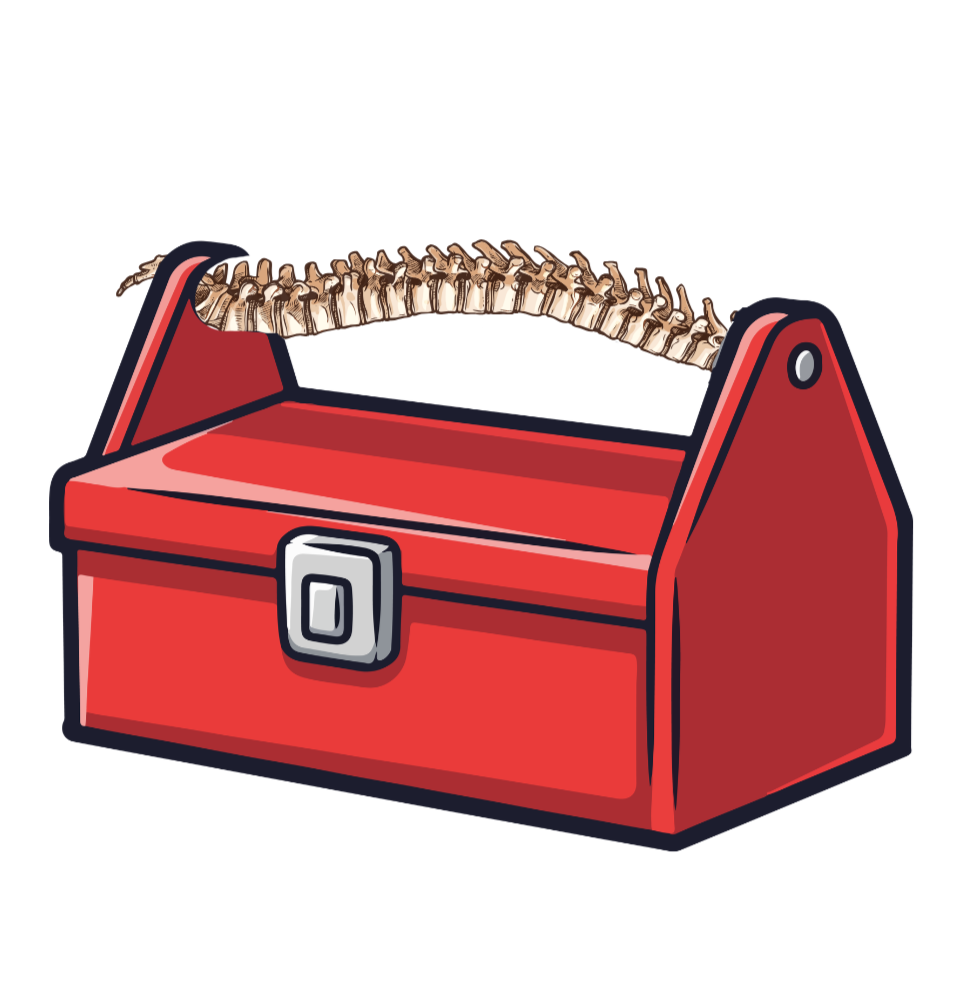
In our TOPS scoliosis and fusion support groups, we often talk about building a ’toolbox’ of self-care tools to help manage the ongoing challenges of living with scoliosis. Think of it as a collection of tools, practices, and understandings that help you live well in your body.
Basically, the idea is to build a relationship with your spine—and your whole soma—that is informed, responsive, and evolving so that you can feel empowered knowing there is something you can reach for - something you can DO to help with day-to-day challenges.
For example, your toolbox might include:
Specific exercises that help you feel aligned - ideally learned with the help of a scoliosis specialist
Decisions regarding lifestyle habits such as nutrition and sleep
Ways of breathing that create space and calm the nervous system (which is always on high alert with scoliosis)
Strategies (and props) for managing discomfort - plus the balls, pillows, and massage guns, etc, that support those strategies
Activities that bring you joy without aggravation - remember, walking is the most important one, but going to a spa or mineral bath is also important!
Supportive care and community - connecting with experienced guides, practitioners, therapists (massage, acupuncture, osteopathy, etc), and friends you can talk to
And just as important… things you’ve learned not to do
Over time, the idea is to develop an intuitive system you carry with you, knowing that you always have a ‘tool’ to reach for.
Start with Breathing and Exercise
It’s impressive how many scoliosis-specific movement techniques are available online and in-person these days. Between Yoga for Scoliosis, Schroth Physiotherapy, Pilates for Scoliosis, Somatics for Asymmetry, Somatic Yoga for Backcare and Scoliosis-focused Strength Training, there are many movement tools to explore.
But how to know where to start? Which one is right for you?
Well, basically, we each have to start with something, and it’s usually easiest to try something that is convenient for you. Ideally, it’s best to find a scoliosis specialist in your area to see in-person, but when that isn’t available, having an online consultation can be a good start.
Remember, building a toolbox is not linear.
It likely involves trying things that don’t work and taking some paths that lead nowhere. But the more you explore, the more people you talk to, and the more people you meet increases your chances of finding a good fit. As you try things, you learn what works for you and, over time, your discernment becomes sharper.
That discernment is one of your most valuable tools.
Let Your Toolbox Change
With experience, as you observe what works and doesn’t work for you, you will likely find that you can let go of some of your old tools as you discover new ones. As your body adapts, compensates, and ages, new needs arise. It’s a natural progression to try new things as you gain insight into yourself, often influenced by learning about alternative approaches by meeting new people.
I am often amazed at the many suggestions that come up in the support groups… a good reason to join one! During each meeting, I learn about all kinds of things that help people, including specific teachers working with various movement techniques, or resources such as books or websites; products such as specific chairs or light therapies; different types of body work or procedures, or information about supplements or vitamins, or pain medications, anti-inflammatory diets, and much, much more.
My Toolbox Has Evolved A Lot Over The Years
For the first several years of my scoliosis and fusion journey, I tried a lot of things, mostly focused on Yoga for Scoliosis and massage therapy. During Covid, when my bad knee became worse, I found that acupuncture was a wonderful way to keep my leg mobile while also discovering how much it could help my nervous system and overall well-being. When I had tried it earlier in my life, I had a terrible experience, so I never thought I would try it again. But thankfully, the combination of my desperation to try anything to calm my knee pain and finding a great practitioner locally allowed me to have a great experience, leading to new-found appreciation for this ancient technique. After I finally had a knee replacement, the acupuncture undoubtedly contributed to my quick and successful healing. And even though my knee is better, I continue to have sessions regularly for everything else.
Around that same time, I discovered Hanna Somatics or Somatic Education—a gentle and effective form of neuromuscular re-education that relieves chronic pain by retraining the brain-muscle connection.
Quite suddenly, without hardly noticing, my toolbox was completely reorganized, where my original tools of Yoga and Massage took a back seat to Acupuncture and Somatics… and it felt like my healing journey went deeper and wider almost overnight.
As many readers know, I became certified in this Somatics technique, and it has become one of my favourite ways of teaching mobility to all bodies, especially those with scoliosis and fusion.
I have continued to do some yoga and massage, but when the acupuncturist also gave me Cranial-Sacral massage—a gentle manual therapy that releases tension in the fascia and connective tissues around the skull, spine, and sacrum to normalize the flow of cerebrospinal fluid—I wondered why I had not been doing it for years! General massage is wonderful, but focusing on the spinal connections makes a lot of sense for scoliotics.
Another very positive addition to my toolbox over the last few years has been Osteopathy - a holistic, hands-on manual therapy system that focuses on the structure and function of the body, particularly the musculoskeletal system. Also an excellent choice for people with twists and curves and other imbalances. It can feel similar to cranial-sacral work, but it goes further. Since my friend and practitioner lives a few hours away, I only go once every one or two months, but each time I have a session, I am happily surprised at how fluid, pain-free and aligned my body feels.
MY Newest Toolbox Additions
As my body shifts - mostly for the better, but also with certain challenges of aging - I find myself constantly curious about trying new things… and/or revisiting some old things.
This has led me to recently add three new things to my toolbox: Reiki, Naturopathy, and Dance!
Reiki
I was introduced by a friend to an energy therapist whose background is in Reiki - a non-invasive energy healing technique used for stress reduction, relaxation, and promoting overall well-being. I have experienced Reiki massage before - in fact, it was the main reason that I chose to get my rods removed (see blog #1), but I have not revisited it for a very long time. Working with this new therapist awakened me to a new desire to connect to my own healing energy in new ways. Not only does she do distance healing, which feels very magical to me, but she also directs an ‘energy collective’ who meet for monthly lessons and discussions, which clarifies the magic. I have also been taking her course called ‘Reclaim Your Capacity to Heal’, which explores Reiki as a way to learn practices that unite body, mind, energy, and spirit. The classes have been incredibly rich with information - the kind of information that I need to read and re-read to fully grasp its complexity - and it feels exciting as it opens up a new understanding of my own healing path in myriad ways.
Naturopathy - with Specific Treatments
As we know, one thing can lead to another.
While learning about energy healing, I was re-awakened to the fact that I have been focusing so much on my spine, that I have been ignoring some of my chronic issues such as arthritis and indigestion - which are very likely related to my spine in some ways, but are their own separate issues that need addressing.
I had previously worked with a naturopath to get help with vitamin supplements, but that was all. Now, through the discussions with the Energy Collective, I became aware of techniques such as ‘Ozone Therapy’, ‘Micro Current Therapy’, and ‘Neuraltherapy’, which have given people amazing positive results for issues exactly like mine. It didn’t take me long to start googling to find someone locally who can offer these services… and I found one! And WHOAH, it has been interesting to say the least. I am fascinated and look forward to more. Stay tuned as I will share more about my experiences as I go deeper into them.
Dance Class
This one caught me by surprise.
When a good friend suggested I join her for an adult contemporary dance class in a local village, my immediate response was a hard NO! After all, it has been about 15 years since I was last teaching in a dance studio, and longer since I was actually taking a class as a dance student. I rolled my eyes just thinking about how I would make a fool of myself… and how it might hurt! My knee, my stiff back, my ego.
But after I hung up the phone, I started remembering how dance class used to give me joy, and I thought, why not? After all, it’s just a community class for all levels, so there is no pressure - plus there is a live accompanist! I thought to myself, what am I so afraid of? Who cares what I look like? I can always stand at the back or just watch if necessary. Why not just go and check it out?
And so that is what I did! And it was super fun and inspiring and uplifting and I was fine. And in some ways, even though I am out of ‘dancing’ shape, I noticed that my body felt healthier and more connected than I remembered. It made me realize that my toolbox over the years has been serving me well… and having that specific tool for feeling JOY had been missing.
And that is another aspect of the toolbox. Sometimes, we have to break out of our safe place and just go for it. Try a new tool. Or in my case, with dance, go back to an old tool that I didn’t think was useful anymore and discover that it still has its place… and it still has ‘life’ in it, as I apply it in a new way.
The Emotional Side of the Toolbox
As much as physical exercises and objects are very important, we must also remember that some of the most impactful tools are not physical at all.
They are things like:
Patience with yourself - we all just do the best we can
Self-trust and self-acceptance - knowing that you know what is best for you
The ability to rest without guilt - learn to notice the hard days and give yourself grace
The courage to say “no” when something doesn’t feel right - change your mind, your tools, your practitioners, your job, your chair… (but say yes when it’s right!)
The willingness to keep giving yourself attention - even when it sometimes feels easier to ignore or deny
Community as a Tool
One of the most overlooked tools is connection.
It is very important for each of us to share our stories with other people who can really understand, so that we don’t feel alone with the strange, specific challenges of scoliosis or fusion.
By hearing how others manage their bodies, we learn about new options, new tools. We can find inspiration in each other’s stories and discover new approaches while staying open to possibilities.
Just a reminder that each person’s situation is unique, and what works for one person may not work for another. Take what resonates. Leave the rest.
You and your body have the final authority!
Also, different countries and regions have different regulations regarding alternative approaches, and insurance does not always cover everything, which often means some treatments are not accessible to everyone (but also keep in mind that medical travel is more and more common, in case you are looking for something specific!).
No matter what, when you start focusing on building your own toolbox, you start building confidence and capacity.
You gain options for working with your own challenges.
On a good day—you know how to move forward. On a difficult day—you know how to adjust. When something flares—you have somewhere to turn.
Ideally, you have a tool for each situation and that leads to a certain knowing.
You can begin to trust that whatever comes next, you will be able to meet it.
And this process—possibly messy, definitely nonlinear, sometimes frustrating—is exactly how your scoliosis toolbox, and perhaps just a ‘LIFE’ toolbox, is built.
***
Interested in receiving our monthly newsletter? Subscribe here.
Read Martha’s next blog post here.
Got comments? Please feel free to write us anytime.